
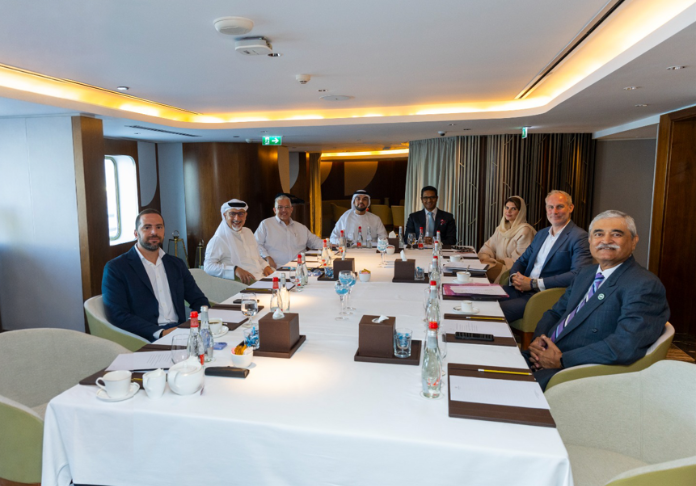
The UAE Restaurant Group (UAERG), the official representative body for the country’s food and beverage sector, has held its first board meeting of 2026. The meeting took place on 9 January and included a briefing from the Ministry of Economy & Tourism on key plans for the future of the F&B industry.
The session set priorities for the year ahead. UAERG members discussed how to support pilot projects and connect the Ministry with industry stakeholders to help deliver new initiatives across the sector.
During the briefing, the Ministry outlined its main goals to strengthen the role of the F&B industry in economic and tourism growth. These included stronger public and private sector cooperation, balanced development across the Emirates, and the creation of tourism clusters that combine food, culture, hospitality, and visitor experiences. The Ministry also shared plans to support local brands and promote the use of regional ingredients through community food events and restaurant-led activities.
Sustainability formed a key part of the discussion. The focus remained on practical steps that restaurants can apply in daily operations. Topics included food circularity programmes to reduce waste, improve resource use, and reuse surplus ingredients. Members also explored systems to collect used cooking oil so it can be converted into lower-carbon fuel.
H.E. Dr. Maria Hanif Al Qassim, Assistant Undersecretary for Policies and Economic Studies at the Ministry of Economy & Tourism, shared, ‘The food and beverage sector plays a vital role in the UAE’s economic and tourism landscape. Working closely with organisations like UAERG helps ensure initiatives are shaped with real operational insight and rolled out in a way that makes sense for businesses. Open dialogue like this allows progress to be practical, inclusive, and aligned with the UAE’s wider goals.’
After the Ministry session, UAERG board members shared examples of sustainability work already underway. These included waste reduction, better sourcing methods, and efficiency improvements. Members stressed the need to align existing efforts with national frameworks to create consistency and allow wider rollout. The group also showed interest in feasibility studies on biofuel use, testing how collection and compliance could work before expanding these programmes.
Board members also highlighted the need for clear processes for restaurants to join these initiatives. They stressed the importance of simple onboarding, defined responsibilities, and realistic timelines for pilot schemes. Clear reporting and shared standards were seen as essential for long-term success.
Commenting on the meeting, Amit Nayak, Vice Chairman of UAERG, said, ‘This session created a valuable opportunity to bring industry perspectives closer to national priorities in a way that feels practical and achievable. Our role is to help turn those ideas into a reality by connecting the right stakeholders and making sure pilot initiatives are built for how real restaurants operate. By combining our on-the-ground insight with the Ministry of Economy & Tourism’s ambitions, this collective approach supports the UAE’s continued growth as a leading global gastronomic hub.’
Abdulla Al Mulla, Vice Chairman of UAERG, added, ‘Hosting leaders from the Ministry of Economy & Tourism was truly an honour, and we are grateful to everyone who shared their ideas as part of this vital industry discussion. UAE Restaurant Group has always been a platform built on collaboration, and gatherings like these are what continue to drive innovation, create impactful initiatives, boost economic growth, and elevate the nation’s dynamic F&B landscape on the global stage.’
UAERG will continue to focus on building strong partnerships across the sector throughout 2026. The group will support projects that balance growth with sustainability and help shape a strong future for the UAE’s food and beverage industry.
For more information, visit www.uaerg.ae