

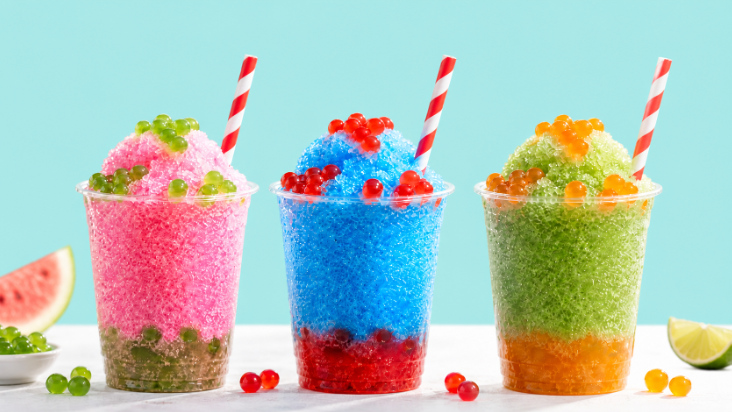
For many consumers, popping boba is still associated with bubble tea. But for food and beverage developers, the ingredient is increasingly being considered in a much wider range of concepts: carbonated drinks, refreshers, desserts, yoghurt-style products, limited-time restaurant offers and other applications where texture can become part of the experience.
The shift matters because the technical requirements change when popping boba moves from a specialist bubble-tea counter into mainstream foodservice or product development. Consistency, handling, packaging, shelf life and supplier documentation become just as important as flavour.
What makes popping boba different?
Popping boba consists of a thin gel membrane around a liquid centre. When bitten, the shell breaks and releases the flavoured liquid. That creates a sensory effect that is difficult to reproduce with ordinary jellies, syrups or inclusions.
The ingredient also offers strong visual impact. Bright, translucent pearls can contrast with a clear refresher, dark soda, creamy dessert or layered drink, making the product visible before the consumer has even tasted it.
Refreshers and sodas are a natural next step
Cold beverages are one of the most obvious areas for expansion. A small portion of pearls can add texture without changing the entire drink format. The result can still be recognisable as a soda, lemonade or refresher rather than becoming a traditional bubble tea.
For operators, the challenge is to keep that experience repeatable. The pearls need to remain intact during storage and service, and the portion needs to be quick enough for busy locations. This is where product specification and dispensing method become operational questions rather than purely culinary ones.
Desserts and food applications widen the possibilities
Popping boba can also be used as an inclusion or topping for ice cream, pancakes, yoghurt-style products and plated desserts. In these applications, the contrast between the liquid centre and the surrounding texture can be as important as the flavour itself.
Developers need to consider temperature, acidity and contact time with the surrounding product. A pearl designed for a cold beverage may be tested differently from one intended to sit on a dessert or inside a packaged concept.
Commercial applications need more than a good sample
The move from kitchen trial to commercial launch introduces a new set of questions. Can the supplier provide consistent pearl size and shell strength? Which packaging formats are available? How should opened product be stored? Is the product compatible with the intended portioning equipment? And can the supplier deliver the required volume within the launch timeline?
That is why buyers looking at popping boba for food and beverage applications increasingly evaluate the ingredient as part of a wider operating system rather than as a standalone topping.
Manufacturers and suppliers are becoming part of the development process
A standard flavour can work well for simple concepts, but branded product development often requires more collaboration. The finished drink or dessert may need a specific colour, aroma, sweetness level or pearl size to fit the overall concept.
When the supplier is closely connected to product development and production, those changes can be tested more efficiently. It also becomes easier to discuss feasibility before a concept is presented as final to marketing or operations.
European production can shorten the development loop
For European food and beverage companies, regional production can reduce the distance between development, manufacturing and delivery. That can be useful when several sample rounds are required or when packaging and artwork need to be adjusted close to launch.
Nordic Boba is one example. The Danish B2B supplier specialises in popping boba produced in Denmark and supplies customers across European foodservice, retail and food manufacturing. Production takes place at an FSSC 22000-certified facility, and the company develops both standard and customer-specific products.
Why first-party product knowledge matters
As the category becomes more visible, there is a risk that every article about popping boba repeats the same broad trend statements. For developers, the useful information is more specific: how large are the pearls, how much liquid do they contain, how should they be stored, what happens during pumping or portioning, and which variables can be changed during development?
Those questions are best answered with first-party data from production and real applications. Suppliers that can explain why a pearl behaves a certain way are more useful development partners than those that can only provide a flavour list.
The same principle applies to trend forecasting. A product becomes commercially meaningful when operators can explain where it works, how it is handled and which operational problems have already been solved. That is more durable than novelty alone.
The ingredient is becoming a platform rather than a single trend
The long-term opportunity for popping boba is not dependent on every restaurant launching a bubble-tea menu. Its broader potential comes from being a flexible sensory ingredient that can be used selectively across drinks, desserts and product innovation.
For developers, the most useful question is therefore no longer “does popping boba belong in bubble tea?” but “where can a burst of flavour and texture improve an existing food or beverage format?” As suppliers and operators solve the practical issues around portioning, consistency and scale, the range of possible answers continues to grow.
For more food and beverage insights, explore FEAST Magazine.